


ARCHAEOLOGY
FIELD SURVEYS IN SOFIA MUNICIPALITY IN 2022 AND 2023
RESUME
2022
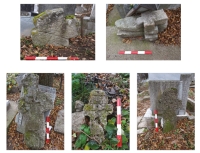
Between October 13th and December 8th 2021, the third field expedition under the project of the Regional History Museum – Sofia for updating and renewal of the Automated Information System – “Archaeological Map of Bulgaria” in the Sofia City Province were conducted. The working area is in the lands of the villages of Lozen, German, Kazichene and Krivina
2023
Between October 12th and November 24th 2021, the forth field expedition under the project of the Regional History Museum – Sofia for updating and renewal of the Automated Information System – “Archaeological Map of Bulgaria” in the Sofia City Province were conducted. The working area is in the lands of the Mladost, Studentski, Lozenets, Triaditsa, Vitosha, Ovcha kupel, Bankya and Lyulin districts.
Alexander Stanev, PhD
Regional History Museum – Sofia
alexander.stanev@sofiahistorymuseum.com
Metodi Zlatkov, PhD
National Archaeological Institute with Museum Bulgarian Academy of Sciences
metodi_man@abv.bg
ARCHAEOMETALLURGICAL RESEARCH OF BRONZE AGE FINDS FROM THE ARCHAEOLOGICAL SITE NEAR CHUKOVEZER
RESUME
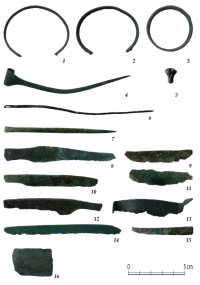
The archaeometallurgical research covers copper alloy artefacts found in the Bronze Age settlement and necropolis near the village of Chukovezer. The archaeological material under investigation belongs to the following categories – bracelets, pins, needles, awls, knives and swords. The compositional analysis of 13 chemical elements (Cu, Sn, As, Pb, Fe, Ni, Ag, Sb, Zn, Au, Mn, Co, Cr) has been performed using X-Ray Fluorescence. The results evidence that most of the metal artefacts are made of tin bronze, except of a pin cast of arsenical copper. Five knives and two bracelets are made of the ternary alloy Cu-Sn-As. Another ternary alloy – Cu-Sn-Pb is prepared for the production of a knife from the necropolis. The comparative study of the correlations between the main elements in the finds from the Bronze Age village and those from the necropolis reveals that there is no definite separation between the two groups. Further examination of the concentrations of the main elements in the different categories of artefacts shows variations primarily in the quantitative values of tin.
Silviya Ivanova, PhD
Regional History Museum – Sofia
silvivanova@abv.bg
Deyan Lesigyarski, PhD
National Institute of Geophysic, Geodesy and Geography Bulgarian Academy of Sciences
dlesigyarski@geophys.bas.bg
THE LATE ANTIQUE COMPLEX IN OBELIA (SOFIA) - A NEW LOOK AT THE RESEARCHES FROM THE 1960S
RESUME
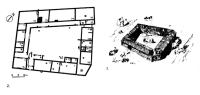
The villa rustica in Obelya (Sofia) is one of the eight similar sites in the immediate vicinity of the provincial capital of Dacia Mediterranea in the Late Antiquity – Serdica. The complex is located 7 km west of the fortified area of the city. It has been excavated during three archaeological campaigns: in 1961, 1962, and 1964. In the archaeological literature the complex is counted among the fully explored ones in the vicinity of Serdica. Through the years, the interpretations of the chronology and the economic development of the site became а benchmark of all the villae rusticae in the proximity of present-day Sofia. In 1981 the results of the excavations have been published in a relatively short article.
Anani Antonov, PhD
National Archaeological Institute with Museum Bulgarian Academy of Sciences
anani_antonov@abv.bg
Editions

Contents of number 1

Contents of number 5
-

